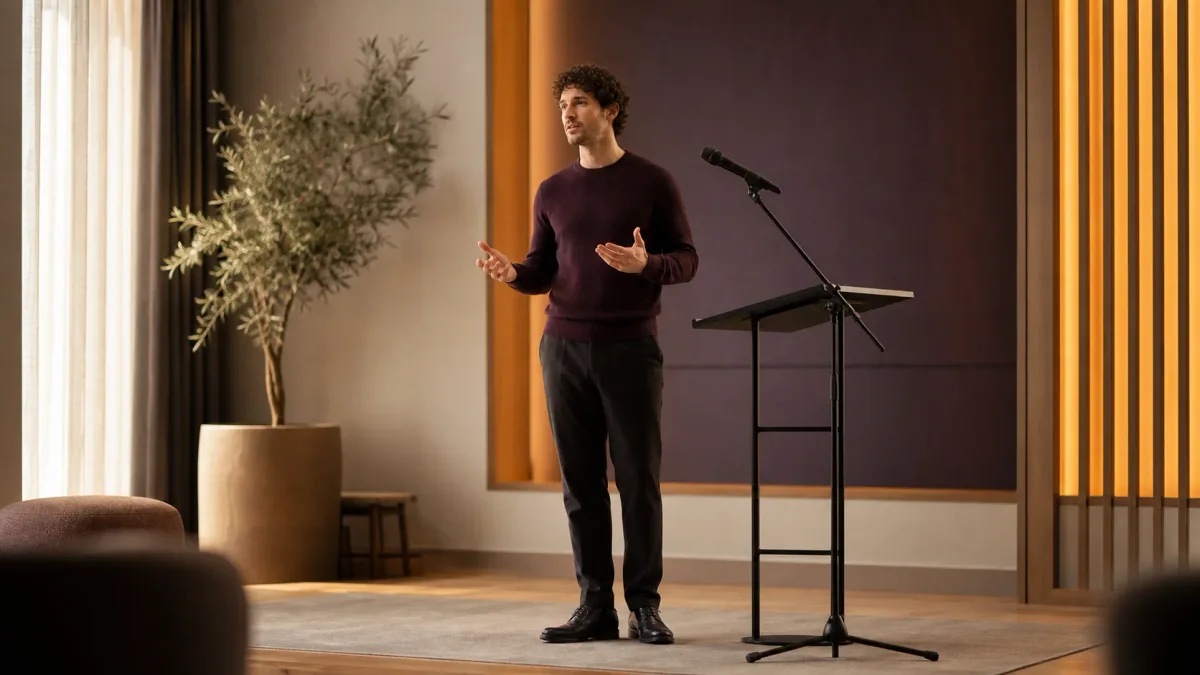
Most "how to improve public speaking" advice is a list: make eye contact, use gestures, slow down, tell a story. None of it is wrong — and each item hides a method underneath it, which is why storytelling in public speaking takes a whole guide rather than a bullet. All of it is useless on its own, because knowing what good looks like is not the same as being able to do it when a room is staring at you.
If you want software to support that loop, start with what makes the best public speaking app useful: out-loud reps, honest feedback, realistic scenarios, and progress you can review. The same practice loop underlies the broader set of speaking skills you use in meetings and one-on-ones, not just on a stage.
Public speaking is a motor skill wrapped in a nerve problem. You improve motor skills the same way you improve a tennis serve or a piece of music: deliberate, repeated practice with feedback on specific mistakes. This guide gives you that loop — and when the format is a formal talk, the specifics of how to give a presentation build on the same foundation.
Here are the ways to improve public speaking, in the order this guide works through them:
- Pick one real thing you actually have to say — a talk, a toast, a meeting point — instead of practising "public speaking" in the abstract.
- Structure it on paper first: three to five points, in order, before you rehearse a single word of delivery.
- Answer three questions about the room — what they already know, what they want, what they will push back on — and cut what fails those tests.
- Say it out loud, standing, at full volume, all the way through without stopping. Silent rehearsal trains the wrong skill.
- Record the run and play it back, listening for one thing at a time: pace, filler words, and the moment you lost the thread.
- Name the single loudest weakness from that playback and look up the fix for that one habit, rather than working on "delivery" in general.
- Fix exactly one weak spot, then run it again. One fix per pass is what makes the reps deliberate rather than repetitive.
- Warm up your voice — breath, hum, one articulation drill, opening line at volume — before any run that matters.
- Rehearse the recovery, so losing your place mid-talk is something you have already done ten times in private.
- Graduate to a real audience: one trusted listener, then a low-stakes work slot, then a room of strangers.
- Repeat three times a week, 10–15 minutes a session. Consistency beats cramming, every time.
Why reading tips is not how to improve public speaking
The skill that breaks down on stage is not knowledge. It is execution under pressure — assembling clear sentences in real time while your heart rate climbs. You cannot read your way into that. You can only rehearse into it.
There is a second trap: silent practice. Running the talk in your head feels productive, but it skips the exact thing that fails out loud. In your head, sentences are smooth and complete. Spoken aloud, they ramble, double back, and fill with "um" and "like." The gap between the two only shows up when you actually open your mouth.
If you only do one thing differently, make it this: practice out loud, at full volume, standing up, as if the audience were already there. Silent rehearsal trains the wrong skill.
Why is improving public speaking worth the effort?
Because the skill is priced into work you are already doing. Employers screening candidates say the same thing every year — more than two-thirds look specifically for verbal communication skills (NACE Job Outlook 2026) — and LinkedIn's 2026 skills report puts executive and stakeholder communication, which explicitly includes public speaking, among the fastest-rising skill categories in the market.
Source: NACE Job Outlook 2026
The everyday version matters more than the résumé version. Most people never give a keynote, but almost everyone has to explain a decision to a room, defend a number in a review, or speak up in a meeting in front of their manager's manager. Those are all the same motor skill, and getting better at it changes how often your ideas get adopted rather than merely heard.
Structure the message before you rehearse it
Rehearsing a rambling first draft just gets you a smoother rambling draft. Before you run the loop below, boil down what you actually want to say into three to five core points, each in one plain sentence. If what you are preparing is a written speech rather than a talk you will speak from notes, how to write a speech covers the word budget and the drafting method before you get to delivery. If you cannot state a point in one sentence, you do not understand it clearly enough yet to say it clearly out loud.
Arrange those points in the order the listener needs them, not the order they occurred to you — usually context first, then the core point, then what it means for them. This is five minutes of work on paper, and it is the difference between rehearsing to fix delivery and rehearsing to fix a talk that never had a clear shape to begin with.
Write those points for the room you are actually walking into. The same idea lands differently for a room of executives who want the conclusion first than it does for a room of peers who want the reasoning shown — decide which one you are rehearsing for before you run the loop, not while you are standing up.
How do you adapt a talk to the audience in the room?
Every generic guide says "know your audience" and then stops, which leaves you with a sentiment instead of an instruction. The usable version is three questions you answer on paper before your first rehearsal, because the answers change the words you end up rehearsing.
- What do they already know? This sets where you start. Explaining what an API is to a room of engineers loses them in ten seconds; skipping it in front of a room of sales reps loses them just as fast. Write down the one sentence you can safely assume they would nod at, and begin immediately after it.
- What do they want from the next ten minutes? A status update, a decision, reassurance, or a reason to care. If you cannot name it, you will default to telling them everything you know — the most common way a well-prepared talk still goes wrong.
- What will they push back on? Name the strongest objection in the room and answer it inside the talk instead of waiting for it in the Q&A afterwards. Raising it unprompted reads as credibility; being caught by it reads as not having thought it through.
Then rehearse the version those three answers produce, rather than a generic version you plan to adjust on the fly. The loop below trains delivery, and delivery is only ever as good as the words it is delivering.
The practice loop that actually works
Improvement comes from a tight, repeatable cycle. Each run is one rep.
1. Pick something real to say
Do not practice "public speaking" in the abstract. Practice the actual talk, toast, pitch, or meeting contribution you have coming up. Specific material gives you specific feedback. If you have nothing scheduled, use a real opinion you hold — a two-minute case for something you believe.
2. Say it out loud, start to finish
No stopping to restart. Deliver the whole thing once, mistakes and all. The goal is not a perfect take; it is an honest baseline of how the words actually come out of your mouth.
3. Record it and play it back
This is the step almost everyone skips, and it is the one that matters most. The recording removes the gap between what you think you said and what you actually said. You will hear the filler words, the rushed transitions, and the sentence that fell apart. It is uncomfortable. That discomfort is the feedback.
4. Fix exactly one thing
Do not try to fix everything — you will fix nothing. Choose the single weakest moment from the playback and address only that. Maybe it is the opening. Maybe it is one tangent that lost you. One change per rep keeps the practice focused and the progress measurable.
5. Run it again
Now deliver it again with that one fix in mind. Then pick the next weakest moment. Three to five passes of this loop will do more than a month of reading articles.
What to actually listen for on playback
When you replay a recording, you need to know what you are listening for. Focus on these, roughly in order of impact:
- Filler words. Count your "ums," "likes," and "you knows." Awareness alone cuts them. The fix is usually a silent pause where the filler used to be.
- Pacing. Most nervous speakers rush. If you sound fast to yourself on playback, you sounded very fast to the room. Mark the spots where you sped up.
- Clarity of sentences. Did each sentence land as a complete thought, or did several run together and lose the point? Tighten the ones that rambled.
- The opening and the close. These carry the most weight and are the easiest to rehearse to the point of being automatic. Nail the first 20 seconds and the last 20 seconds.
Which weakness should you fix first?
Playback hands you a list of problems and no order to attack them in, and the order is not obvious. Some habits cost you the room inside the first thirty seconds; others are polish you can safely leave until month two. Match the loudest thing you heard to the row below, work only that row for three sessions, then re-record and see what has moved to the top.
| What you hear on playback | What it actually is | Where to start |
|---|---|---|
| "Um," "like," "so" every few words | A gap-filling reflex, not a vocabulary problem | how to stop using filler words |
| The run is noticeably faster than you remember giving it | Nerves driving pace — the single most common fault | how to stop talking too fast |
| Every sentence lands on the same note | No pitch or volume variation | how to stop sounding monotone |
| Word endings disappear and people ask you to repeat | Articulation and jaw tension | how to stop mumbling |
| Thin, quiet, or out of air by the end of a sentence | Breath support, not confidence | how to project your voice |
| Sentences start well and then wander off | Composing in real time with no shape to land on | how to stop rambling when you talk |
| You can hear the tremor in the first minute | A physical stress response with a physical fix | how to stop your voice from shaking |
| It sounds fine on tape, but you dreaded doing it | The nerve problem rather than the motor problem | how to overcome fear of public speaking |
One row at a time. Working two rows at once is the most reliable way to make no measurable progress on either — and the row you pick should be the one a stranger would notice first, not the one that embarrasses you most.
What your body says while you're rehearsing
Audio playback catches your words. It misses everything your body does while you say them, and that is half of what a live audience actually reacts to. Once the loop above feels natural on audio, switch your phone to video for a few reps and watch with the sound off first — you are checking what the room sees, not what it hears.
- Weight and stance. Rehearsing while shifting your weight from foot to foot reads as nerves even when your voice sounds steady. Plant your feet, distribute your weight evenly, and only move with intent — a step toward the camera to land a point, not a sway.
- Hands. Pockets and crossed arms shrink you. Fidgeting with a pen or your clothing pulls attention off the sentence you are saying. Rehearse with your hands doing something useful instead: gesturing to size up a number, counting off a list, opening your palms on your key point.
- Eye line. On video, check whether you are actually finishing sentences while looking at one spot before moving to the next, or sweeping the room so fast that no one feels seen. Slow, deliberate holds read as confidence; a fast scan reads as nerves.
Treat what you see the same way you treat what you hear: pick the single most distracting habit from the video, fix only that one thing on the next rep, and leave the rest alone until it is the turn to fix them. If you want the full order to work through — base, hands, movement, face, eye line — body language for public speaking ranks each signal by how much a room actually notices it.
How do you warm up your voice before you speak?
Most advice on improving public speaking stops at the neck. That is a real gap, because the first ninety seconds of a cold start are where voices come out thin, tight, and half a step too high — and the audience forms its read of you in exactly that window. A cold voice is not a confidence problem. It is a mechanical one, and four minutes fixes it.
Run this immediately before any rep that matters, and before the real thing:
- Breathe low, four in and four out, six times. Put a hand on your belly and make that move, not your shoulders. If your chest is rising, the breath is too shallow to support a full sentence, which is why long sentences run out of air at the end.
- Hum up and down your range for thirty seconds. Lips closed, easy volume. Humming gets the vocal folds moving without strain — it is the vocal equivalent of jogging before you sprint.
- Do one articulation drill, twice. "Red leather, yellow leather" or "unique New York," slowly and over-precisely, then at normal speed. Exaggerating the consonants wakes up the muscles that stop you swallowing word endings.
- Say your opening line out loud, at full room volume, twice. Not muttered — the volume you will actually need. This is the step people skip, and it is the one that matters most: your first real sentence should never be the first sentence your voice has made that day.
If you only have sixty seconds — you are next up and there is no time — do step 1 and step 4. Breath support and one loud rehearsed opening line carry most of the benefit; the hum and the drill are the polish.
The warm-up is also a diagnostic. If your voice still sounds thin at full volume after four minutes, the problem is support rather than nerves, and how to project your voice covers the mechanics in depth. If it sounds flat rather than thin, the fix is variation rather than volume — see how to stop sounding monotone.
What actually goes in a strong opening and close
"Rehearse your opening and closing" tells you to drill the words. It does not tell you what words to put there, and that gap is where most openings go generic — a throat-clearing "thanks for having me" instead of something that earns attention in the first ten seconds.
Open with the moment, not the topic. Instead of "Today I want to talk about how our onboarding process is failing new users," open with the moment that proves it: "Last Tuesday a new hire spent forty minutes stuck on a form our onboarding never mentioned." One is a topic sentence; the other is a scene the room can picture, and it earns the topic sentence that follows it for free.
Close by returning to that same moment, not by summarizing your slides. If you opened with the stuck new hire, close by saying what changes for them once your fix ships. The callback does two things a generic "in conclusion" close cannot: it signals the talk is actually finished, and it leaves the audience with the one thing you most want remembered, instead of a recap of everything you said.
How do you keep a room's attention while you're speaking?
The loop above fixes how you sound. It does nothing for the eight-minute mark, where a room that started attentive has quietly drifted to its phones — and that drift is not a delivery failure. Attention is built into the material before you rehearse it. Four moves do most of the work, and all four are cheap enough to add to a talk you have already written.
- Ask a question you do not actually want answered. "How many of you have shipped something you knew wasn't ready?" pulls a room back without surrendering the floor, because people answer it in their heads before they can stop themselves. Plan one at roughly the one-third mark, which is where the first dip reliably lands.
- Convert your hardest idea into something they already own. An analogy is not decoration; it is the only way an unfamiliar idea gets stored. "Our retry logic is a voicemail that redials every thirty seconds and never checks whether you picked up" does more than a correct paragraph of explanation. Picking the right comparison is its own skill — how to explain complex ideas simply covers how to build one that holds up.
- Change something every few minutes. Drop your volume for a sentence. Take two steps. Go to a black screen. Tell a thirty-second story. Attention renews on contrast, and a talk with no contrast in it reads as one long paragraph no matter how well it is delivered.
- Let the humour be true rather than funny. The safest laugh in any talk is a specific thing that genuinely happened to you, told straight — the time you presented the wrong quarter's numbers to the wrong committee. It costs nothing if it doesn't land, because it was still a real story. Written-in jokes fail loudly; recounted mishaps do not.
Rehearse these the same way you rehearse everything else: add one of the four to your material, run the loop, and listen on playback for whether it sounded planted or natural. A rhetorical question delivered at the same pace as the sentence before it does not register as a question at all.
What do you do when you lose your place mid-talk?
You will lose it at some point, and how you handle the next four seconds matters far more than the slip itself. The instinct is to apologise, speed up, and fill the gap with noise. All three make it more obvious. Do the opposite.
Stop, and take one breath. Silence reads to the audience as a deliberate pause — they cannot see your notes or hear the panic. Then use one of three recoveries:
- Repeat your last complete sentence. Saying it out loud again almost always reloads the sentence that was supposed to follow it, and to the room it just sounds like emphasis.
- Ask a question you already planned. "Does that match what you're seeing?" buys ten seconds of completely legitimate airtime while you find your place again.
- Jump to your close. If the thread is genuinely gone, land the ending you rehearsed word for word instead of wandering around looking for the middle. A talk that ends early and cleanly beats one that limps.
This is worth rehearsing, not just reading. Once a week, deliberately stop yourself mid-rep, take the breath, and run the recovery — so the first time it happens in a real room is not the first time you have ever done it.
Do slides help or hurt while you are still improving?
Mostly hurt, at this stage, and for a reason that has nothing to do with design. A deck quietly converts rehearsal into reading. You click, you glance up, you narrate the bullet — and you have practised operating a slideshow rather than speaking. That is why a talk that felt solid in rehearsal falls apart the moment the screen does.
Four rules keep the deck from eating the practice:
- Build the talk first, the deck second. Structure your three to five points on paper and run the loop on them at least twice with no slides at all. If the talk does not hold up in an empty room with nothing on the wall, slides will not save it — they will only hide the gap from you.
- One idea per slide, and never the sentence you are about to say. A slide that contains your line puts you in competition with yourself: the room reads it in two seconds and then waits for you to catch up. Put the evidence on the slide — the chart, the photo, the single number — and keep the sentence in your mouth. If that habit has already set in, how to stop reading off your slides works through the three causes and the fix for each.
- Rehearse at least one full run with the screen off. This is the rep that tells you whether you actually know the talk. It is also your insurance: projectors fail, the adapter is wrong, the room has no HDMI. A speaker who can deliver the whole thing cold loses nothing when that happens.
- Black the screen when you are not using it. Press B in most presentation software and the display goes dark. Attention returns to you immediately, which is exactly what you want during a story, a question, or your close.
None of this argues against slides. It argues against rehearsing with them too early, which is the specific mistake that makes people think they are practising when they are really just clicking. On a video call the trade-off shifts again — the deck is often the only thing on screen — and how to give a virtual presentation covers what changes when your face is a thumbnail.
5 tips for improving your public speaking skills
These are not a substitute for the practice loop above — they are what to actually apply during each rep. Public speaking improves fastest when a handful of specific fixes get rehearsed, not when a longer list of advice gets read.
- Slow down on purpose. Nervous speakers rush because finishing fast ends the discomfort sooner, but speed reads as anxiety and blurs your words. Deliberately dropping your pace is the single fastest way to sound more in control, and it buys your brain a beat to find the next sentence.
- Pause instead of filling the silence. Swap "um," "like," and "you know" for a half-second of quiet. The pause feels long to you and completely invisible to everyone listening — it reads as composure, not hesitation.
- Rehearse your opening and closing lines word for word. The first and last twenty seconds carry the most weight and are the cheapest confidence you can buy, because you never have to improvise the two moments that matter most.
- Land your sentences instead of trailing off. Carry your volume through to the final word. A dropped ending undercuts everything strong that came before it, even if the rest of the delivery was solid.
- Warm up your voice before you start. Say your opening line out loud once, cold, a few minutes before the real thing. It prevents the thin, shaky sound of a cold start and gets your breath support working before the pressure hits.
Pick just one of these five for your next practice rep. Trying to apply all five at once is how people end up improving at none of them — the loop above already tells you how to isolate one fix per pass.
Borrow one technique from a speaker you admire
Watching a speaker you think is genuinely good is useful — but only if you extract one specific, nameable thing from it, not vague inspiration. Pick a talk you actually admire and watch it once for content, then a second time watching for one thing only: how they open, where they pause, how they use their hands, or how they land the ending.
Name that one technique in a sentence, then put it into your next practice rep instead of your own default habit. This turns "watch more good speakers" — advice that rarely changes anything on its own — into another input for the loop above rather than a substitute for it.
Where do you find a real audience to practice on?
Solo reps with playback build the mechanics fastest, because you can run twenty of them in the time one meeting takes. What they cannot manufacture is stakes — a live audience that reacts, gets bored, or interrupts. Eventually you need that, and the answer to "where" is more concrete than most guides admit.
Work up in roughly this order:
- One trusted person. A partner, a friend, a colleague who will actually tell you the truth. Ask for one specific note rather than "how was it" — "did you lose me anywhere?" gets a usable answer.
- A low-stakes work slot. Volunteer for the five-minute update at a team meeting, or run an internal lunch-and-learn on something you already know cold. Real audiences, almost no downside.
- A speaking club. Toastmasters is the well-known option: cheap, weekly, and the format makes you speak impromptu as well as prepared. Local meetup groups and improv classes work for the same reason — scheduled, recurring reps in front of strangers. If a weekly evening meeting does not fit your life, Toastmasters alternatives compares what each replacement actually covers.
- A class or a coach. Worth the money once you already know your specific weaknesses, so you are paying for correction rather than for a beginner's overview you could have had free.
A panel is worth adding to that list once you have a few reps behind you. It is the lowest-preparation live slot there is — you answer questions for ninety seconds at a time instead of holding a room for twenty minutes — and how to speak on a panel covers the format's own rules, which are not the same as a talk's.
None of these replaces the loop; they are the rung above it. The people who improve slowest are the ones who join a club and then only ever speak there, collecting one rep a fortnight. Keep rehearsing on your own between sessions and every live slot becomes a test of the work rather than the only practice you get.
How long until you actually improve
Faster than you think for filler words and pacing — often within a handful of focused sessions, because awareness drives most of the gain. Confidence under real pressure takes longer, because it comes from repeated, lower-stakes exposure. The point of rehearsing the real talk out loud is that the room is no longer the first time you have said the words. By then you have already said them ten times.
Source: Cleveland Clinic
That number is the reassuring part: nervousness is the default, not a personal failing. It also means the bar is low. Most people never practice out loud at all, so the few who do stand out quickly.
A simple weekly routine
If you want a concrete schedule, this is enough to improve noticeably:
- Three sessions a week, 10–15 minutes each. Short and frequent beats long and rare.
- One piece of material per session, run through the loop three to five times.
- One metric to track, usually filler-word count or whether you finished without losing the thread.
Consistency matters more than intensity. The speaker who does fifteen honest minutes three times a week will pass the one who crams for two hours the night before a talk.
Key takeaways
- Public speaking is a motor skill, so practice it with reps, not reading.
- Structure your 3-5 core points on paper before you start rehearsing delivery.
- Always rehearse out loud — silent practice trains the wrong thing.
- Record and play back; the recording is your honest feedback.
- Fix one thing per run, not everything at once.
- Repeat the loop until the words come out clean under mild pressure.
- Answer three audience questions on paper first — what they know, what they want, what they'll push back on.
- Rehearse the recovery too: breathe, repeat your last sentence, or jump to your close.
- Warm the voice up first — four minutes of breath, hum, articulation drill, and your opening line at full volume.
- Graduate from solo reps to a real audience — one trusted listener, then a work slot, then a speaking club.
- Name the one loudest weakness on playback and fix that habit specifically — not "delivery" in general.
- Build attention into the material: a planted question, an analogy, a change every few minutes, one true story.
- Rehearse without slides first, and keep one run with the screen off.
Frequently asked questions
What is the fastest way to improve public speaking?
Record a two-minute run of real material, play it back, fix one specific thing, and run it again — three times a week. Filler words and pacing improve within a handful of sessions because awareness alone does most of the work there. Confidence under pressure takes longer and comes from repeated exposure, not from more reading. What does not work is practising silently or reading another list of tips.
How do I improve public speaking if I have no upcoming talk to practice?
Use real material you already care about. Make a two-minute spoken case for an opinion you hold, explain a project you are working on, or summarize an article out loud. The loop works on any real content — you do not need a stage, only something genuine to say and a way to record it.
How do I stop saying um and other filler words?
Awareness does most of the work. Record yourself, count the fillers on playback, and you will start catching them in the moment. The replacement is a short silent pause. Silence feels long to you and natural to listeners, so let the pause sit instead of filling it. For the full method — a fillers-per-minute baseline, the three filler types, and the transition drill that removes the gap they fill — see how to stop using filler words.
How can I improve my public speaking skills on my own?
Entirely on your own is the fastest way to start, because solo reps are the only practice you can run three times a week. Say real material out loud at full volume, record it, name one weakness from the playback, fix that, and run it again. What solo practice cannot manufacture is stakes — a room that reacts, gets bored, or interrupts. Add that on top once your recordings sound clean: one trusted listener, then a low-stakes work slot, then a club or a class.
How do I improve public speaking as an introvert?
Nothing in the loop requires being outgoing. Introversion is about where your energy comes from, not about how clearly you speak, and rehearsed solo reps suit it better than group workshops do. Two adjustments help: over-prepare the opening and close so you are not improvising at the two moments that drain you most, and schedule genuine recovery time after a talk rather than treating the exhaustion afterwards as evidence you are bad at it.
How do I improve public speaking in English as a second language?
Separate the two problems before you practise, because they have different fixes. Fluency — vocabulary, grammar, finding the word — improves with input and conversation. Delivery — pace, breath, sentence endings, stress on the right syllable — improves with the loop in this guide, and it is usually the one doing the damage. Most second-language speakers are far more intelligible than they think and are simply speaking too fast; slowing down and landing your word endings buys more clarity than any amount of extra vocabulary. How to improve speaking skills covers the fluency side in depth.
Should I use slides when I practise public speaking?
Not for your first few reps. A deck turns rehearsal into reading — you click, glance up, and narrate the bullet, which practises operating a slideshow rather than speaking. Build the talk on paper, run the loop at least twice with nothing on the wall, and only then add slides. Keep one full run with the screen off so a failed projector costs you nothing.
Is it better to memorize a speech or speak from notes?
Memorize the opening and the close word for word, and speak the middle from a short list of points. Full memorization sounds stiff and collapses if you lose your place; pure improvisation rambles. Anchoring the two highest-stakes moments gives you confidence without sounding scripted.
Why do I sound worse when I practice out loud than in my head?
Because in your head the sentences are already finished. Out loud, you assemble them in real time, which is the actual skill public speaking requires. Sounding worse at first is not a setback — it is the first honest look at what needs work.
What should I do with my hands and body when I'm speaking?
Give them a job instead of trying to hold them still. Gesture to size up a number, count off points on your fingers, or open your palms on your key sentence — purposeful movement reads as confidence, while pockets, crossed arms, and fidgeting read as nerves. The fastest way to catch bad habits is to rehearse on video with the sound off once, so you are judging what the room sees instead of what it hears.
Do I need to join Toastmasters or take a public speaking class?
No, but it can help once your solo reps have you sounding clean and structured. Solo practice with playback builds the core skill fastest because you get more reps per week than any class gives you. A live audience — Toastmasters, a work meeting, a friend's event — adds a different ingredient: real stakes and real reactions, which is worth adding on top of solo reps, not instead of them.
Conclusion
Reading tips tells you what good speaking looks like; it does not change how you sound. Speaking is a motor skill, and motor skills improve one way — reps out loud, honest playback, one fix at a time. Close the tab and run the loop; that is the part that moves the needle.